

Where the money goes
Putting an independent civilian presence at sea, building monitoring tools, and ensuring safety, mobility, and documentation capacity in an area of the Mediterranean increasingly marked by human rights violations: this is what we are committed to doing.
Between January and May 2026, almost all the resources raised through donations were used to make TOM’s civilian presence in the Mediterranean fully operational.
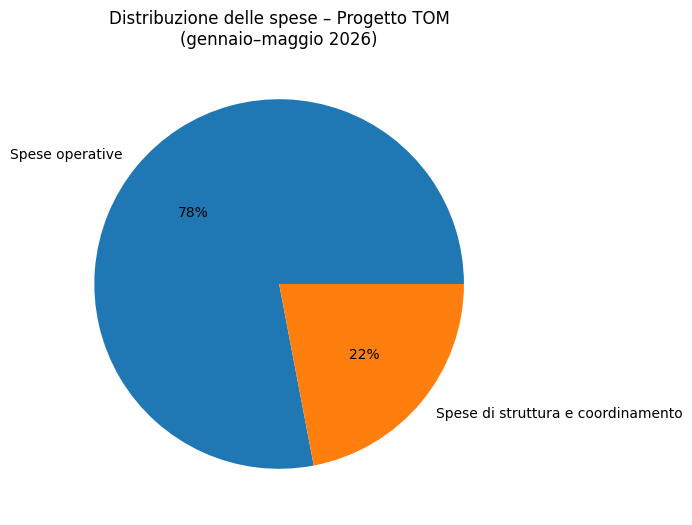
The breakdown of expenses shows that around 78% of resources were allocated directly to the project’s operational activities: boat maintenance and preparation, fuel, logistics, travel, technical equipment, connectivity, insurance, safety, and life on board.
The remaining 22% covered coordination and structural costs: administration, organizational management, operational support, and the collaborations necessary to ensure the continuity and sustainability of the project.
Donations therefore mainly supported concrete operational activities: putting an independent civilian presence at sea, building monitoring and documentation capacity, and ensuring continuity in observation activities across the Mediterranean.
Between January and May 2026, the TOM project — All Eyes on the Mediterranean — used all donated resources to build and activate a civilian monitoring presence in the Mediterranean. The income recorded during this period came entirely from contributions dedicated to the project, including two major bank transfers of €35,000 and €20,000.
The expenses clearly show how the funds were used primarily for three major goals: preparing the vessel, ensuring crew mobility, and building the technical and organizational infrastructure required for observation and documentation activities.
A significant portion of the resources was dedicated to the technical preparation of the vessel and its maintenance. During these months, mechanical repairs, nautical maintenance, and the purchase of technical materials, equipment, hardware, and components necessary for safety and operations at sea were carried out. The expenses therefore include shipyards, mechanics, fuel, mooring, and technical supplies.
A second major area concerns logistics. The project covered numerous travel costs to allow crew members, technicians, and collaborators to reach ports, shipyards, and operational locations across Italy and the Mediterranean: ferries, trains, flights, fuel, tolls, local transport, and temporary accommodation. These expenses reflect continuous coordination work and mission preparation activities.
Donations also supported the human work required to keep the project alive. The accounts include professional fees and ongoing collaborations connected to TOM’s operational, administrative, technical, and communication activities. These are the people responsible for organizing missions, documentation, coordination, and building the project’s support network.
Part of the funds was also used for communications and connectivity: domain renewals, satellite connections, digital tools, and essential services required to maintain a constant presence at sea and ensure the transmission of information.
Finally, many expenses concern essential goods for the daily life and safety of the crew: food supplies, medicines, onboard materials, and small provisions purchased directly in operational ports, especially in Licata, which emerges as one of the project’s main logistical hubs.